Inside Florimel

Every way back in.

Florimel is made of many small doors, each borrowed from a proven way memory lets itself be reached. You won’t need them all; you only need the one that opens for you.

The scaffolding

Building the scaffolding of your life.

Florimel helps you lay out the anchors that memory is filed under: places, schools, work and people. A bare date is a famously poor way in. A place, a period of work, the people nearby, that is how memory actually indexes the past.

Onboarding

One of your first sessions

At first, you will find a short guided flow to enter some of the basics you remember (date of birth, the places you lived, schools, work, the people who mattered...). It takes minutes to sketch and becomes the map everything else hangs on; you can fill it partially, correct it, update it, nothing is written in stone.

Timeline, Periods and Subchapters

The app’s home surface

Your life is greater than a vertical track of periods and places you lived in, but it’s a good start. For each chapter, you can add as many details as you want: subchapters that hold a person, a job, a hangout...

The journey map

One step from the timeline

The same periods, shown as places on a map. Where you were is one of memory’s strongest cues, so Florimel lets you meet your life spatially as well as in time.

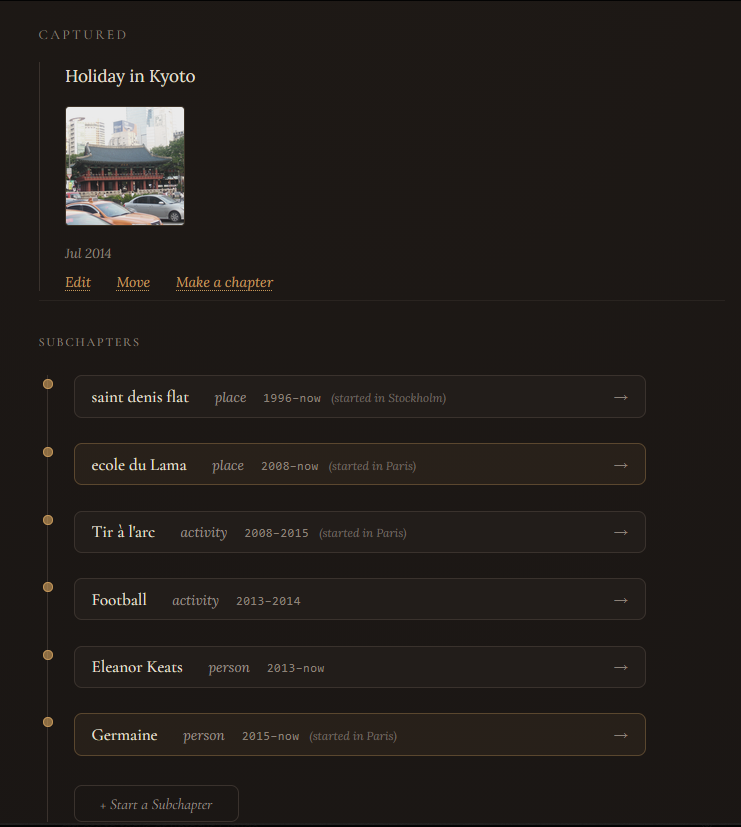
A Florimel period showing a captured memory and a list of subchapters: places, activities and people, each with its span of years.
Inside a period, Subchapters hold the people, places and activities of that stretch of life.
The cues

Ways in, drawn from your own life.

These are the heart of Florimel and the many ways for you to recall some old memories. Each feature is a gate to gently reach memories directly. Every cue is either something you said, quoted exactly, or a real public fact, clearly framed as the world’s memory rather than yours.

The facts conversation

Usually the first door opened

A quiet, one-question-at-a-time conversation for a period: who was around, what a normal day looked like, the smell and sound of the place, what you listened to... Every question can be skipped, and skipping is respected.

Sensory prompts

Inside the facts conversation

What a place smelled like, what you could hear from your room, what the afternoon light did. Smell in particular reaches old, transporting memories that words rarely touch. Your answers quietly rebuild the feel of the period.

Era Soundtrack

Once Spotify/Last.fm is connected

Music is a powerful memory anchor for some people. We help you rediscover old songs; up to you to see where it leads.

Photos and Street View

Adding photos

Same as music, a photo can bring back so many memories (the good old family photo album did have a purpose). Florimel reads when and where it was taken and files it into the right chapter.

World cues

What happened back then?

While you write about a year, Florimel can offer a real dated event from that year and country. Public events are time anchors people naturally date their lives against. Easily hidden, never mixed into your words.

Paper Trail

Grab those old calendar entries

Import an old calendar and walk it one entry at a time. For each entry, you can make it a chapter, write the memory it triggers or let it go.

Echoes

More from your past entries

Your own passing remarks return as soft invitations to enrich, a few at a time. Feelings and private thoughts are deliberately never echoed back at you.

Thresholds

Between the edges

We remember the unique better than the habits. The moments you crossed from one life into another are natural chapter breaks. Where two of your periods meet, Florimel asks about the crossing: what you packed, who you said goodbye to or the first morning in the new place.

The Rhythm

Breaking the habits

Name the routines of a period and keep them as cards: the commute, the Sunday call... Later they become doorways, because remembering the pattern first, then the day it broke, is how memory for repeated life works.

Constellation and Entity Chips

Find the hidden links between chapters

Every person and place you enter becomes a point you can open, to see their whole arc across your life. When Florimel spots a new name in your writing, it offers it as a chip to confirm with one tap, never a list to fill in.

Quiet notes and On this day

Occasionally, small reminders

Sometimes, Florimel will pop up a welcome back, an observation, “around this time a year ago…” or one open question. It surfaces only your own dated content and it can be turned off entirely.
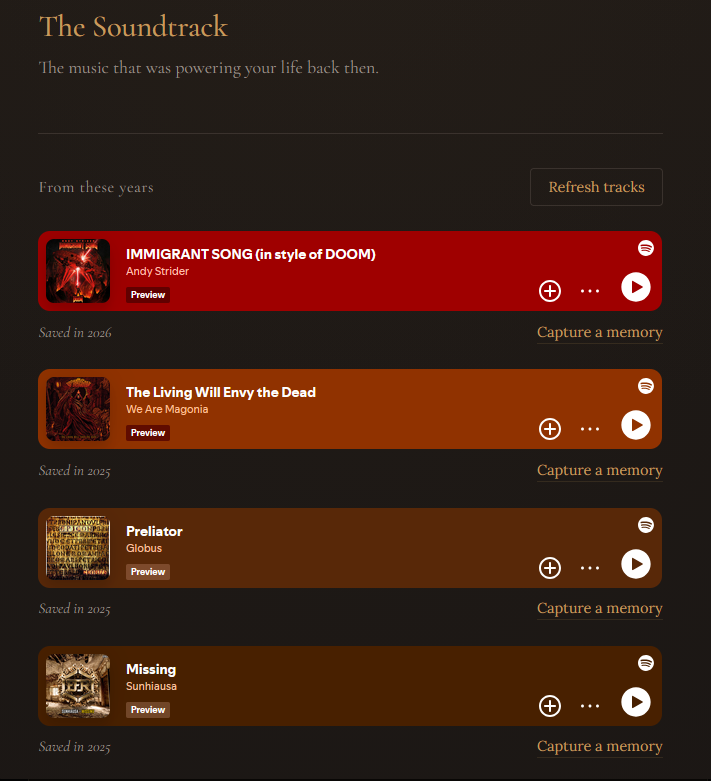
The Florimel Era Soundtrack, a list of tracks from a period’s years with an option to capture a memory beside each one.
The Era Soundtrack: the music of a period’s years, with a quiet invitation to write beside each track.
The writing

Where what surfaces is set down.

Cues invite; writing keeps. These are the surfaces where a memory becomes words, each self-paced, private, and never pushing you anywhere you would rather not go.

The story canvas

From any period page, the “just write” door

A quiet, auto-saving page: your words, with optional whispered cues at the margin you can ignore completely. What people volunteer without prompting is their most accurate memory, so the blank page is honoured too.

Reflect further, the deep dive

A link on a period page, after the facts exist

When a period matters, a longer, slower conversation moves from outer facts toward single scenes, and remembers what you said before. Each pass builds more connections, and connection is what makes a memory findable again.

Capture

On the recall hub, its first card

For memories that surface at the wrong moment. Open it, speak or type a few lines, done. Speed matters: unrehearsed detail fades fast. Voice is transcribed and the audio immediately discarded.

The atmosphere line

At the top of a period page, once it has texture

From your scattered answers, the stairwell smell, the tram, the low winter light, Florimel distils one evocative sentence and sets it at the head of the chapter. It condenses your own words; it never adds to them.

Letters to your future self

In the app’s quieter corners

Write to the person you will be, and choose a delivery date. When it arrives you meet your past voice exactly, a perfect key to a whole season of life, and you practise the felt thread between who you were and are. The letter stays in the app.

Coming back

Memories like to be visited

They rarely come out on the first knock. Coming back to them, gently and with the right spacing, is what makes them stay. We build that rhythm for you, without ever turning it into homework.

Look back

Reach first, then compare

We tell you where and roughly when a detail lived, then let you reach for it before showing your original words. Why? Because trying to remember strengthens a memory far more than being shown it. No score, no timer... just the reaching.

Second pass

The questions you skipped, offered again

“I don’t remember” often just means “not today”. A month or more later, we quietly re-offer the questions you skipped for lack of recall, one at a time. The ones you declined as private? Those stay declined.

The weekly letter

In your inbox, only if you want it

A short note: what you added, one door you might open next, maybe a line of that week in history. No streaks, no points, no guilt, it even pauses itself when you’re away. Unsubscribing is one click.

Keeping it honest

Your story, only ever in your words.

Here’s an uncomfortable fact: a memory is rebuilt every time you recall it, so a tool that writes your past for you can quietly rewrite it. We take that seriously. Our guardrails are specific and you can check every one of them.

No ghostwriting, ever

Everywhere you write

We never draft, extend or improve a memory. We may spot a name in your text, condense your own fragments into an atmosphere line, or transcribe your voice... and that’s it. Polished invented prose is exactly how false memories are made, so you won’t find any here.

Escape hatches

Under every single question

“I don’t remember clearly” and “I’d rather not go there” are two different answers, and we treat them differently. Press someone for an answer and you get a guess, and guesses harden into memory. So nothing here ever presses.

Neutral, ordinary prompts

The way we phrase things

“What could you hear from your room?” rather than “what was your hardest moment?” The wording of a question shapes what you remember, so ours stay plain, everyday and free of assumptions.

The confidence question

One last thing, before you close

How clear did that feel? Lived memory, or partly rebuilt from photos and other people’s stories? An honest archive knows the difference. Your answer is kept quietly and never turned into a score.

When memory turns heavy

Some doors you get to keep closed.

Let’s be clear: Florimel is not therapy, and never pretends to be. But we know some corners of a past weigh more than others, so we follow trauma-informed principles: choice, pacing and control stay with you, always.

Meaningful ways out

Wherever it might sting

“I’d rather not go there” is honoured for good. We will not steer you back to ground you’ve declined, not in a cue, not in a question, not ever. You decide what gets approached, and when.

Grounding

One tap away, never forced on you

If remembering stirs up more than you expected, one tap opens a quiet page: three slow beats back to the room, the light, the day you’re actually in. No clinical language, no ratings, and an easy way back or out.

The journal vault

Write it down, then put it away

Some things need to be written once, and then left alone. The vault locks a period’s writing behind a deliberate two-step unlock, and locked words never resurface in any cue, echo or review. You look again when you choose to... or never.